
Staying Sober: A Personal Realignment
How I understand the 12 Steps, on my own terms.
Why I'm Writing This
When I first entered recovery, I expected support. What I didn't expect was how quickly sobriety would become tangled up with other people's interpretations of how I was supposed to achieve it.
Within my first couple of days in rehab, I was already questioning the Twelve Steps. I struggled with the idea that I was supposed to surrender my will, accept what I was being told, and follow a prescribed path without questioning why. I've had a problem with that kind of thinking my entire life. If I'm going to do something, I want to understand why I'm doing it.
A nurse at the rehabilitation center recognized what I was struggling with and handed me a SMART Recovery book. I dove into it. Its cognitive behavioral approach made sense to me because it emphasized understanding my thoughts, recognizing my behaviors, and taking responsibility for my choices.
But I wasn't looking for a reason to dismiss AA. I could see people succeeding with the program. I could see the value of the fellowship, of being in a room with people who understood what I was going through. I wanted to find a way to benefit from that without having to surrender my own understanding of recovery.
What I continued to encounter, however, was an attitude that there was only one acceptable way to get sober. Work the Steps. Get a sponsor. Follow the program as you're told. Don't question it.
When Support Became Judgment
And then there was an experience that still sticks with me.
I overheard three AA members betting on when I would relapse. One guessed “next three months.” Another said sooner. Another said “30–60 days.”
At a time when I was already vulnerable, hearing people turn my sobriety into a betting pool was devastating. It wasn't the first time I'd heard people make predictions about someone else's recovery, sometimes disguised as a joke. But when it was my own sobriety being discussed, it hit differently.
I was angry. I had come to AA looking for support, and instead I felt as though I was being judged against someone else's definition of what my recovery should look like. I began questioning not only those individuals, but AA itself.
What I didn't fully understand at the time was that AA meetings are autonomous, with each group having its own group conscience. Those three members didn't represent AA as a whole, and their behavior didn't define the program or its intended purpose. But in those early days, I hadn't yet learned to separate the actions of individuals from the fellowship itself.
Questioning What I Was Being Told
My anger pushed me to look more closely at AA. Initially, I wanted to find everything I could that was wrong with it. I questioned its history, its literature, its traditions, and the way its principles were being presented to me.
But the more I learned, the more I began to distinguish between what AA actually says and what some people insist it means.
And one question kept coming back to me:
Was I not one who had a desire to stop drinking?
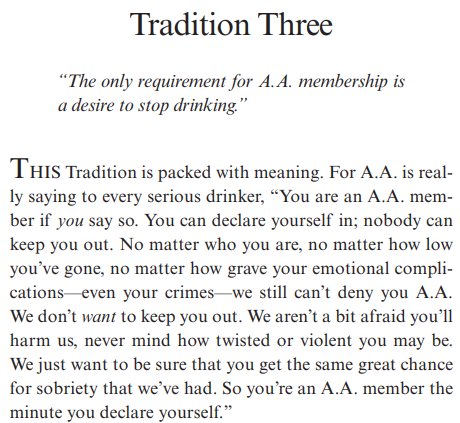
That is the only requirement for AA membership, as stated in Tradition Three.
Stepping Away and Coming Back
For a while, I stepped away from AA and explored SMART Recovery. I found value in its approach and took tools from it, but I missed the fellowship of AA. SMART Recovery offered meetings, but not the frequency and variety I had found in AA, and that mattered to me.
So I returned.
I began to understand that the behavior and opinions of individual members did not define AA as a whole. Each group has its own group conscience, and not every meeting approaches recovery in the same way. I found meetings where I could participate, listen, share, and benefit from the experiences of others without having to adopt every interpretation of the program as my own.
AA helps countless people get sober and stay sober. It provides fellowship, support, and a place to return to when someone is struggling or has relapsed. I've seen people succeed through the Twelve Steps, sponsorship, and their understanding of a Higher Power. I respect that, and I don't want to diminish what AA has meant to them or what it continues to offer.
But I also know what it feels like to encounter people who insist that their interpretation is the only acceptable path. People who tell you that you must work the Steps a certain way, that you must have a sponsor, or that questioning their approach means you're doing recovery wrong.
I don't believe those individuals get to decide whether I belong in AA or how I must approach my own sobriety.
And I don't believe AA is the only path to sobriety in the first place.
The Destination Is Sobriety
There are other approaches, including SMART Recovery, Recovery Dharma, and combinations of different methods. What works for one person may not work for another. What helps someone at the beginning of recovery may not be what they need later.
I can value the fellowship of AA, examine its Twelve Steps, and take what I find useful without accepting that the entire program must be followed in one prescribed way. I can draw from other approaches without having to abandon AA.
The destination is sobriety. The path I take to get there is my choice.
Why I'm Writing This Now
That's why I'm writing this.
If someone comes into AA and finds that the traditional approach works for them, I hope they find everything they need to stay sober. But if someone encounters resistance, feels overwhelmed, or begins questioning whether they belong because they don't approach recovery the same way as others, I want them to know that they have choices.
They don't have to abandon the fellowship simply because they disagree with someone's interpretation of the program. They can explore other approaches, ask questions, find meetings that work for them, and decide which tools help them maintain their sobriety.
This article is my personal examination of the Twelve Steps. It explains how I understand them, what I take from them, and where my interpretation differs. It isn't a set of instructions for anyone else's recovery.
I don't have a sponsor. I haven't worked the Steps in the traditional manner. I don't believe that another person's experience gives them authority over my recovery, nor do I believe that I must surrender my free will to remain sober.
My decision to stop drinking was mine. My responsibility for maintaining that decision is mine as well.
I'm sharing my perspective because I know what it felt like to question whether I belonged simply because I wasn't following the path others expected of me.
I want someone who is struggling with that same question to know that they can examine their options, make their own decisions, and find a path that works for them.
And regardless of whether I work the Steps in the traditional manner, have a sponsor, or share another member's understanding of a Higher Power, I remain a grateful member of Alcoholics Anonymous.
I have a desire to stop drinking. That is the only requirement for membership.
How I Understand the Twelve Steps
I didn't write this because I owe anyone an explanation of whether I work the Steps. Being questioned about my recovery led me to examine them more closely for myself. Some made sense to me right away. Others took time, questions, and different perspectives before I found anything useful in them. My understanding may continue to change.
These are not instructions for anyone else's recovery. They're my interpretations of the Steps and what place, if any, they have in mine.
Step 1
“We admitted we were powerless over alcohol—that our lives had become unmanageable.”
I can acknowledge that my drinking had reached a point where I needed to stop. I don't interpret that as being powerless over every choice I make today. I made the decision to stop drinking, and I remain responsible for the choices I make in my recovery.
Step 2
“Came to believe that a Power greater than ourselves could restore us to sanity.”
I don't see this Step as a requirement to explain or defend my personal beliefs. I can recognize the value of help, perspective, and support without believing that my ability to make choices depends on a Higher Power. How I understand this Step, and whether I use it in my recovery, is my decision.
Step 3
“Made a decision to turn our will and our lives over to the care of God as we understood Him.”
I can accept that there are things in life I cannot control. That doesn't mean I have to surrender my free will or hand responsibility for my decisions to someone else. I can let go of trying to control everything around me while remaining accountable for what I choose to do.
Step 4
“Made a searching and fearless moral inventory of ourselves.”
At first, I understood this Step as making a list of everything wrong with me, and I questioned what that would accomplish. Then someone explained a moral inventory to me as being like going through a pantry. You look at what's expired, what you're running low on, what's still good, and maybe discover an unusual spice that gives your pantry its own flavor.
That was my aha moment. An honest inventory includes what's good about me, too. Recovery is a lot like cooking: sometimes I make a quick snack, sometimes a full meal, but I'm always going back to the pantry, using what I have and figuring out what I need. For me, a moral inventory is something I keep doing, not one big list I make and set aside.
Step 5
“Admitted to God, to ourselves, and to another human being the exact nature of our wrongs.”
I can be honest with myself about my mistakes, but I don't believe I have to confess them to another person. Talking something through with someone I trust can be helpful, and I may choose to do that. What I question is treating disclosure as a requirement rather than a choice. I've had this Step presented to me as a reason I need a sponsor, but I don't interpret it that way. I can examine my behavior and take responsibility for my mistakes without owing anyone a confession.
Step 6
“Were entirely ready to have God remove all these defects of character.”
I don't believe I'll ever be free of every character defect. I'm human, and recognizing something about myself that needs work doesn't mean I can simply have it removed. Going back to the pantry, I might find something that's expired, something I need to replace, or even a brand that no longer works for me. I can recognize those things and decide what to do about them. What I question in this Step is the idea that God must remove my shortcomings for me. I can accept help and guidance, but making changes in my life is still my responsibility.
Step 7
“Humbly asked Him to remove our shortcomings.”
I see Steps Six and Seven as two parts of essentially the same idea: first becoming ready to have my defects removed, then asking for their removal. Bill W. considered “defects of character” and “shortcomings” interchangeable, as explained in correspondence from 1963 and 1965.¹
My difficulty with Step Seven is the same as with Step Six. I don't believe every human flaw can simply be removed, and I don't believe personal change requires asking God to remove it. I can recognize where I fall short, accept help, and remain open to change, but I remain responsible for what I do next.
¹ AA General Service Office: Why did Bill W. use “defects of character” and “shortcomings”?
Step 8
“Made a list of all persons we had harmed, and became willing to make amends to them all.”
Looking at my past includes recognizing how my actions affected other people. I can acknowledge that harm without turning the exercise into a list of reasons to punish myself. The point, for me, is to be honest about what happened and consider what responsibility I have now.
Step 9
“Made direct amends to such people wherever possible, except when to do so would injure them or others.”
I understand the purpose of making amends, but I question how rigidly this Step is sometimes presented in meetings. Making amends is more than saying I'm sorry or seeking forgiveness. It means acknowledging the harm I've caused and changing the behavior that caused it. Direct contact isn't always appropriate, even when it's possible. AA's own literature calls for judgment about when and how to approach someone.² I can take responsibility for my past without accepting that I must revisit every person I've harmed.
² Twelve Steps and Twelve Traditions, Step Nine, pp. 83–87. Read AA’s Step Nine chapter .
Step 10
“Continued to take personal inventory and when we were wrong promptly admitted it.”
To me, this Step is about recognizing when I'm wrong without immediately becoming defensive. I can acknowledge a mistake, take responsibility for it, and address it rather than letting it sit. That's part of maturity, not just sobriety, and something I can continue to practice throughout my life.
Step 11
“Sought through prayer and meditation to improve our conscious contact with God as we understood Him, praying only for knowledge of His will for us and the power to carry that out.”
I see value in prayer, meditation, and taking time to reflect. What I question is the assumption that reflection must mean seeking a Higher Power’s will for me. I know AA has a chapter called “We Agnostics,” but being free to define a Higher Power doesn't resolve that question for everyone. I can seek understanding, recognize my part in a situation, and consider someone else's perspective while remaining responsible for my own decisions. If others find direction through their understanding of a Higher Power, I respect that. It doesn't have to be the way I approach this Step.
Reference: Alcoholics Anonymous, “We Agnostics,” pages 44–57 .
Step 12
“Having had a spiritual awakening as the result of these Steps, we tried to carry this message to alcoholics, and to practice these principles in all our affairs.”
This is where I have my strongest disagreement with the Steps. The wording assumes a spiritual awakening as the result of these Steps. AA later explained that such an awakening need not be sudden or dramatic, but changing how an awakening is described doesn't answer my question: why must it be the result of working these Steps?³
I can share my experience, support another person, and practice principles I believe in without claiming a spiritual awakening or following all twelve Steps. I respect that this path works for others. What I reject is the idea that it must work for me, or that my sobriety is somehow less valid because I take a different path.
³ Alcoholics Anonymous, Appendix II, “Spiritual Experience,” pp. 567–568. Read AA’s appendix .
Final Thoughts
When Suggestions Become Demands
I came to AA because I wanted to stop drinking. My early experiences were difficult enough that I left. People were betting against my sobriety, and I was trying to find my footing in a fellowship I didn’t yet understand. I didn’t know what a group conscience was, what it meant to have a home group, or how decisions were made. When I asked questions, I sometimes got instructions instead of explanations: get a sponsor, do ninety meetings in ninety days, work the Steps, just say yes.
I understand that those suggestions come from approaches that have helped other people. What I question is when a suggestion becomes a demand, or when someone takes their interpretation of the Steps and places it on the person sitting next to them. Each group has its own conscience, and each person brings their own understanding. That variety can be a strength. But it can also make a newcomer feel as though they have to find the right meeting and say the right things before they’re welcome.
I’ve been called a white-knuckler. I’ll own that term, but I don’t accept it as a reason to dismiss my sobriety. I made a decision to stop drinking, and I continue to make that choice. I value the fellowship I’ve found in AA, even though I don’t follow every part of the program as others do.
My Recovery, My Responsibility
That’s why I’ve written about the Steps as my interpretations, not instructions. Some have helped me understand myself. Others raise questions I’m not willing to set aside simply because someone tells me not to question them. I can respect a person who finds direction through a sponsor, the Steps, or a Higher Power without believing I must follow the same path.
AA says the only requirement for membership is a desire to stop drinking. I take that seriously. When someone comes into a meeting with that desire, I don’t want my opinions about recovery to become another obstacle in their way. I know what it feels like to be on the receiving end of that.
No Single Tide, No Single Truth
The tide changes, and so can our understanding. That’s part of why I started Tides & Truth: to have a place to put my thoughts down as life ebbs and flows. Some thoughts belong in the Morning Drift. Others are fragments of what the tide leaves behind, the jetsam I pick up along the way. Some things stay with me; others wash back out to sea. That doesn’t mean everything I believed before was wrong. It means I can keep learning without demanding that everyone arrive at the same answer.
We don’t have to be on the same beach, the same island, or even in the same ocean. Recovery takes us through different waters. Sometimes the seas are rough, and sometimes they’re calm. We may choose different courses, but we can still recognize what we have in common: we’re each trying to find our way.
No single tide, no single truth. I can share what works for me, listen to what works for someone else, respect the course they choose, and trust myself to chart my own.